
Introduction
In today’s digital economy, visibility on Google Search and Google Maps is no longer optional—it is the foundation of customer acquisition. Let’s learn How to rank your website on Google.
Whether you run a local business, an e-commerce brand, or a service company targeting global clients, your ability to appear in search results determines your revenue potential.
Yet most businesses struggle with three critical questions:
- Why is my website not ranking on Google?
- How do I appear in Google Maps (Local Pack)?
- What actually works in modern SEO beyond theory?
This guide provides a strategic, execution-focused, and real-world SEO framework designed from the perspective of a senior marketing strategist working with high-growth businesses and competitive industries.
Question 1: What Actually Determines Rankings on Google Today?
Google does not rank websites based on tricks—it ranks based on trust, relevance, and authority signals.
However, in modern SEO, these are not abstract ideas. They translate into four measurable systems:
1. Content Relevance System
Google evaluates:
- Does your page fully satisfy search intent?
- Is it deeper and more useful than competitors?
2. Authority System
Google measures:
- Who is referencing your website?
- Are you trusted by other credible sources?
3. User Experience System
Google tracks:
- Time on page
- Bounce rate
- Engagement patterns
4. Technical Accessibility System
Google checks:
- Can it crawl your site efficiently?
- Is it mobile-friendly and fast?
Strategic Insight:
SEO is no longer “optimization.” It is authority engineering + user satisfaction design.
Question 2: How Long Does It Take to Rank on Google?
Ranking timelines depend on competition intensity and authority gaps.
- Low competition keywords → 3–6 months
- Medium competition → 6–12 months
- High competition → 12–24 months
Strategic Insight:
Websites don’t “rank fast.” They accumulate trust velocity over time.
Businesses that publish consistently and build authority assets outperform those relying on short-term SEO tactics.
Question 3: Why Is Keyword Research a Business Strategy, Not a Technical Task?
Most businesses fail because they target keywords instead of customer intent.
Weak Strategy:
- “Restaurant”
- “Dentist”
Strong Strategy:
- “Best Bangladeshi restaurant in Abu Dhabi for families”
- “Emergency dentist open late near me”
Framework: Intent Layer Model
- Informational Intent → “how to…”
- Commercial Intent → “best…”
- Transactional Intent → “buy… near me”
Strategic Insight:
Ranking is not about keywords. It is about capturing buyer psychology.
Question 4: What Is a High-Performance On-Page SEO System?
High-performing pages follow a structured architecture:
Core Elements:
- Title optimized for intent + CTR
- Meta description designed for engagement
- One clear H1 hierarchy
- Semantic H2/H3 structure
- Internal linking cluster model
- Image optimization with contextual ALT text
Advanced Strategy:
Use topic clusters, not isolated pages.
Example:
- /google-maps-seo (pillar page)
- /local-seo-strategy
- /google-business-profile-optimization
- /local-backlinks-guide
Strategic Insight:
Google ranks topical authority ecosystems, not single pages.
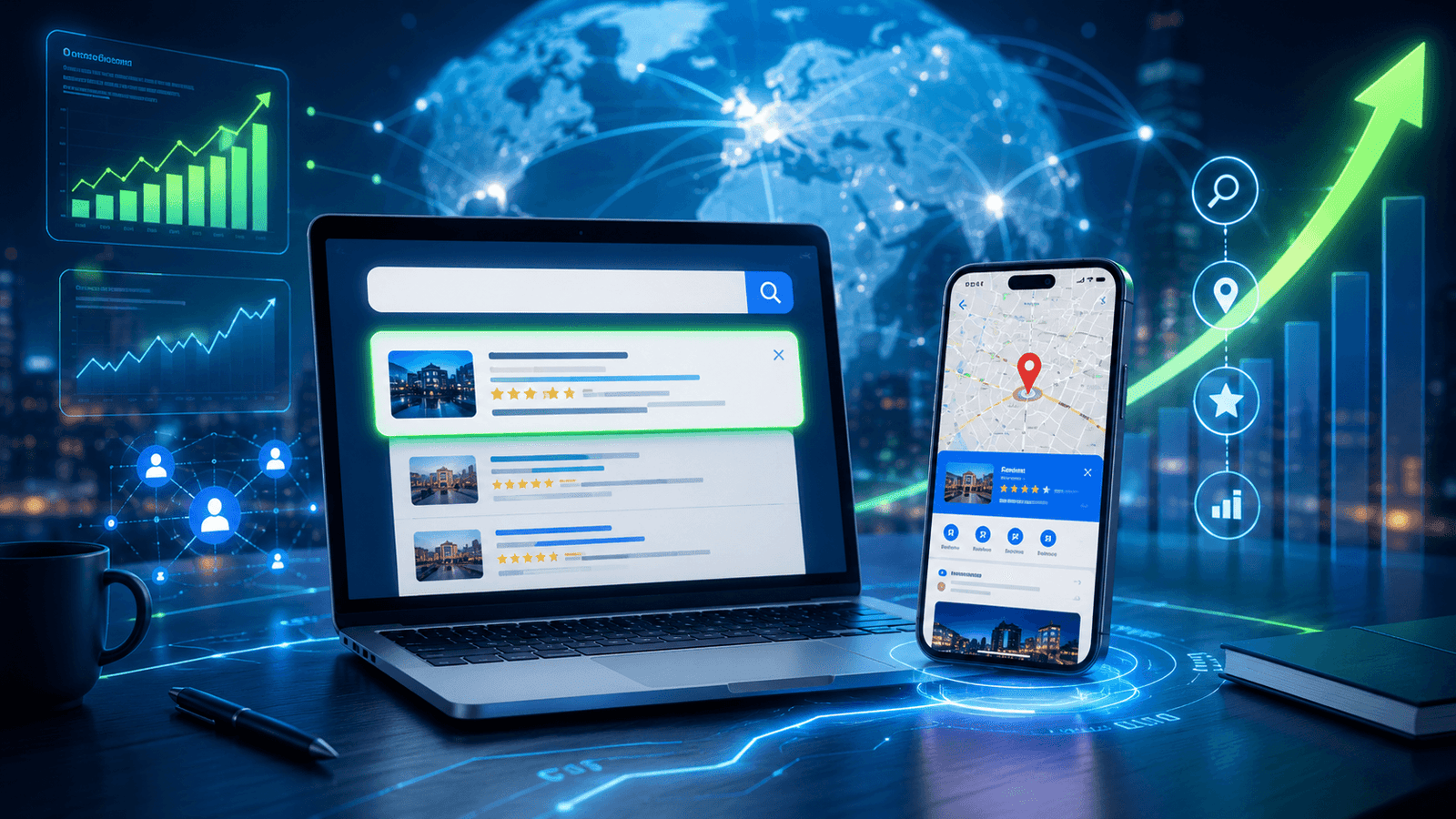
Question 5: How Do You Rank on Google Maps (Local Pack)?
Google Maps ranking depends on three core signals:
1. Relevance
How closely your business matches search intent.
2. Distance
Proximity to user location.
3. Prominence
Your overall online authority.
Prominence is built through:
- Customer reviews
- Local citations
- Brand mentions
- Backlinks
- Search volume for brand name
Strategic Insight:
Google Maps ranking is essentially offline reputation translated into digital signals.
Question 6: Why Reviews Are a Ranking Engine (Not Just Feedback)
Reviews are not social proof—they are ranking signals.
What matters:
- Review volume
- Review velocity (frequency)
- Keyword relevance in reviews
- Response behavior from business
Advanced Strategy:
Encourage natural review language like:
“Best dental clinic in Abu Dhabi for emergency care”
This reinforces topical relevance.
Question 7: What Is Local SEO Really About?
Local SEO is not just optimization—it is geographic market domination.
Core Components:
- Google Business Profile optimization
- NAP consistency (Name, Address, Phone)
- Local citations
- City-specific landing pages
- Hyperlocal backlinks
Strategic Insight:
Local SEO is about building territorial authority signals in Google’s index.
Question 8: Why NAP Consistency Matters
NAP inconsistencies weaken trust signals.
Example:
- ABC Dental Clinic LLC
- ABC Dental Clinic
- ABC Clinic
Google treats this as multiple entities → authority dilution.
Strategic Insight:
Consistency creates entity clarity in Google’s knowledge graph.
Question 9: How to Build High-Quality Backlinks in 2026?
Backlinks are not quantity-based anymore—they are contextual authority endorsements.
Effective Methods:
1. Digital PR
- News mentions
- Industry publications
2. Guest Authority Content
- Niche websites with relevance
3. Resource-Based Link Building
- Guides, statistics, frameworks
4. Local Partnerships
- Chambers of commerce
- Local associations
Strategic Insight:
A backlink is valuable only when it confirms your authority in a topic cluster.
Question 10: Is Blogging Still Powerful for SEO?
Yes—but only when treated as an authority-building system.
Weak Blogging:
- Generic articles
- Keyword stuffing
Strong Blogging:
- Data-driven insights
- Case studies
- Expert frameworks
- Problem-solving content
Strategic Insight:
Modern blogging is not content creation—it is authority documentation.
Question 11: Why Technical SEO Is Non-Negotiable
Technical SEO ensures crawl efficiency and ranking eligibility.
Key Elements:
- Core Web Vitals optimization
- Mobile-first performance
- Clean URL structure
- Structured data (Schema)
- XML sitemap & robots.txt
- Fast hosting infrastructure
Strategic Insight:
Technical SEO does not improve rankings—it removes ranking barriers.
Question 12: What Is Schema Markup and Why It Matters?
Schema helps Google understand context.
Types:
- LocalBusiness Schema
- FAQ Schema
- Product Schema
- Review Schema
Benefits:
- Rich results visibility
- Higher CTR
- Better entity recognition
Strategic Insight:
Schema improves how Google interprets your brand entity.
Question 13: Real Case Study – Local Business Growth System
Client: Multi-location service business
Challenges:
- No Google Maps visibility
- Weak local authority
- No review strategy
Strategy Implemented:
- Google Business Profile optimization
- Location-based landing pages
- Review acquisition system
- Local backlink campaign
Results (6 months):
- 220% increase in organic traffic
- Top 3 Google Maps rankings
- 3× lead generation increase
Strategic Insight:
SEO success comes from system design, not isolated tactics.
Question 14: Common SEO Mistakes That Kill Growth
- Keyword stuffing
- Buying low-quality backlinks
- Ignoring mobile optimization
- Inconsistent NAP data
- Publishing thin content
Strategic Insight:
Most SEO failures are not technical—they are strategic misalignments.
Question 15: 90-Day SEO Execution Framework
Phase 1
- Technical audit
- Keyword mapping
- Google Business optimization
Phase 2
- Content production (pillar + supporting pages)
- Review generation system
- Local citations
Phase 3
- Digital PR
- Guest posting
- Conversion optimization
KPI Targets:
- +30% organic traffic
- +20% local visibility
- +15% conversion rate
Question 16: Is SEO Still Relevant in the AI Era?
Yes—SEO is becoming more competitive, not less.
AI has increased content volume but reduced content quality differentiation.
Winning Factors:
- Real expertise (E-E-A-T)
- Brand authority
- First-hand experience
- Structured data
Strategic Insight:
AI rewards authentic human authority signals, not generic content.
Question 17: What Is the Formula for Long-Term Google Dominance?
The SEO Growth Formula:
Authority + Trust + Content Depth + Technical Excellence + Consistency = Market Dominance
This applies to both:
- Google Search
- Google Maps (Local Pack)
Conclusion
Ranking on Google is not a marketing tactic—it is a business growth system.
Companies that dominate search results consistently:
- Understand customer intent deeply
- Build authority ecosystems
- Maintain technical excellence
- Execute consistently over time
The SEO game is not about speed. It is about compounding digital authority.
The businesses that understand this principle will dominate search visibility for years.
