
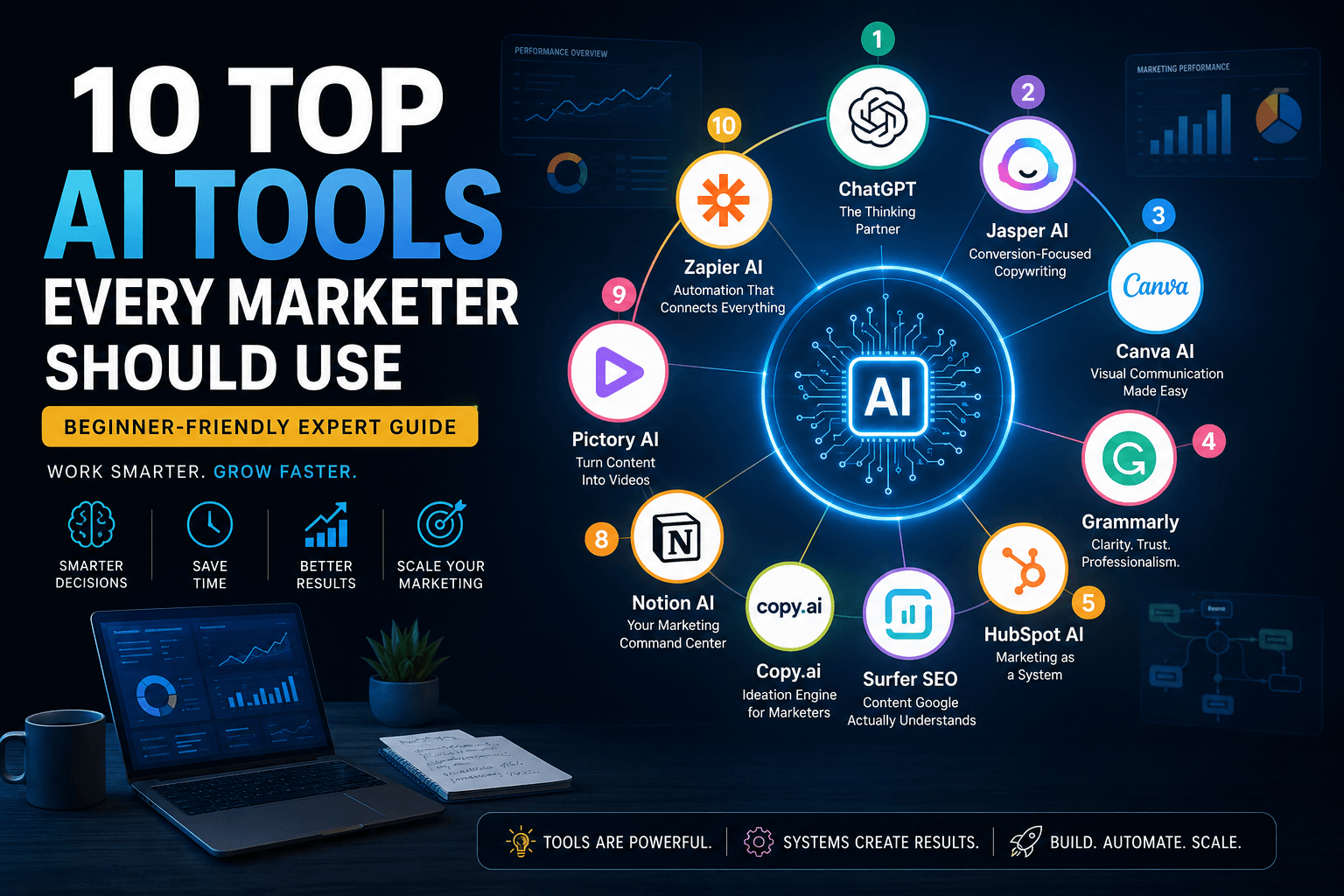
Marketing today is no longer about “doing more work.” It is about making better decisions faster using the right systems. let’s Discover the 10 Best AI tools for marketers should use in 2026. This beginner-friendly guide explains how tools like ChatGPT, Jasper, Canva AI, and Surfer SEO help you create, optimize, and automate marketing like a pro.
best AI tools for marketers are not magic shortcuts. They are leverage tools—they take one marketer and allow them to perform like a full team. But only if you understand what each tool is actually doing, and where it fits in a real workflow.
So instead of listing tools randomly, I want you to think like a strategist. Each tool below solves a specific marketing problem. Your job is to learn when and why to use them—not just what they are.
1. ChatGPT – The Thinking Partner Behind Modern Marketing | best ai tools for marketers
Let’s start with the tool that has quietly changed how marketers work: ChatGPT.
But here’s what beginners misunderstand—it is not just a writing tool. It is a thinking extension.
What it actually helps you do:
- Break down complex marketing problems
- Generate structured content strategies
- Create first drafts of ads, emails, landing pages
- Simulate customer thinking (“what would my audience feel or ask?”)
- Turn vague ideas into actionable plans
How professionals use it differently:
A beginner asks:
“Write me an Instagram caption.”
A professional asks:
“Act as a performance marketer. My product is X. My audience is Y. Give me 5 emotional hooks, 5 logical hooks, and explain why each would convert.”
That difference is everything.
Real insight:
ChatGPT is most powerful not when it gives answers—but when it helps you think in structure, not chaos.
2. Jasper AI – Where Marketing Copy Becomes Systematic
If ChatGPT is flexible, Jasper AI is structured around persuasion.
What it’s built for:
- Conversion-focused copywriting
- Brand-consistent messaging
- Landing pages designed for sales
- Ad copy variations at scale
Why marketers still use it:
Because writing marketing copy is not creative writing—it is psychology applied through words.
Jasper helps enforce proven frameworks like:
- Attention → Interest → Desire → Action (AIDA)
- Problem → Agitation → Solution (PAS)
Practical example:
Instead of writing one ad, marketers use Jasper to generate multiple tested variations of:
- Headlines
- Hooks
- Calls-to-action
Then they test performance instead of guessing.
Key takeaway:
Jasper reduces “random writing” and pushes you toward structured persuasion.
3. Canva AI – The Bridge Between Ideas and Visual Communication
Good marketing fails every day because it is poorly presented.
Canva AI solves that gap.
What it actually solves:
- Visual communication without a design team
- Fast campaign creatives
- Social media consistency
- Brand presentation at scale
What beginners miss:
Design is not decoration. It is clarity engineering.
A good design does one job:
Make the message understood instantly.
Real-world workflow:
A marketer writes an offer → Canva turns it into:
- Instagram ads
- Story posts
- Presentation slides
- Promotional banners
Expert insight:
The goal is not “beautiful design.”
The goal is clear and instantly readable marketing assets.
4. Grammarly – The Invisible Layer of Professional Trust
Grammarly is often underestimated because it feels simple. Professionals use it for a different reason entirely:
It protects credibility.
In marketing, trust is fragile. One unclear sentence can reduce conversion.
What it actually improves:
- Sentence clarity (removes confusion)
- Tone alignment (confident vs weak messaging)
- Professional consistency
- Error elimination before publishing
Real marketing use:
Before publishing ads, emails, or landing pages, marketers run everything through Grammarly—not for grammar alone, but for message sharpness.
Key insight:
Good marketing writing is not complex writing. It is impossible-to-misunderstand writing.
5. HubSpot AI – Turning Marketing Into a System, Not Random Activity
This is where marketing becomes real business infrastructure.
HubSpot AI is not a content tool—it is a relationship system.
What it handles:
- Lead capture and tracking
- Email automation sequences
- Customer segmentation
- CRM-based personalization
Why it matters:
Most beginners think marketing ends when someone clicks.
Professionals know:
Marketing starts after the click.
Example system:
- User signs up
- HubSpot tags interest category
- Automated email sequence begins
- Behavior is tracked
- Offers are personalized
Core idea:
Marketing without systems = effort.
Marketing with systems = scalability.
6. Surfer SEO – Writing Content Google Actually Understands
SEO is not about “writing more.” It is about writing in a way search engines can interpret correctly.
Surfer SEO acts like a content intelligence tool.
What it analyzes:
- Top-ranking competitor pages
- Keyword usage patterns
- Content structure expectations
- Missing topics in your article
How it changes your writing:
Instead of guessing what to write, you see:
- What headings are required
- What topics are missing
- How deep the content should be
Beginner mistake:
Writing content based on opinion.
Professional approach:
Writing content based on search intent + competitor structure + optimization data
7. Copy.ai – The Ideation Engine for Fast Marketing Output
Marketing is not about having one good idea. It is about producing many ideas and selecting the strongest.
Copy.ai helps you scale ideation.
What it’s used for:
- Ad variations
- Product descriptions
- Social captions
- Email subject lines
Why it matters:
Most campaigns fail not because of execution—but because of weak creative options.
Real workflow:
Marketers generate:
- 20 hooks
- 10 CTAs
- 5 angles of persuasion
Then they test, refine, and iterate.
Insight:
Creativity in marketing is not inspiration-based. It is volume-based refinement.
8. Notion AI – Your Marketing Brain and Command Center
If tools are your team, Notion is your management system.
What it does:
- Organizes campaigns
- Stores ideas and strategy documents
- Tracks content calendars
- Builds marketing knowledge systems
Why it matters:
Without structure, even good marketers lose direction.
Real use case:
A marketer running multiple campaigns uses Notion to:
- Track content performance
- Store ad variations
- Organize customer insights
- Plan weekly execution
Key insight:
Marketing success is often less about creativity—and more about organized execution.
9. Pictory AI – Turning Written Content Into Video Assets
Video is not optional anymore. It is the dominant format.
Pictory AI solves a major problem: repurposing content.
What it does:
- Converts blog posts into videos
- Creates short-form content automatically
- Adds visuals and voiceovers
- Helps scale content across platforms
Why it matters:
One idea should not stay one format.
A single blog can become:
- YouTube video
- Instagram reel
- TikTok clip
- LinkedIn post
Insight:
Modern marketing is not creation—it is distribution across formats.
10. Zapier AI – The Automation Layer That Connects Everything
This is where professionals separate themselves from beginners.
Zapier AI connects your entire marketing ecosystem.
What it does:
- Automates workflows between tools
- Eliminates repetitive manual tasks
- Connects leads, emails, CRMs, spreadsheets
Example automation:
When someone subscribes:
- They enter CRM
- Receive welcome email
- Get tagged by interest
- Added to newsletter flow
All without human intervention.
Key insight:
Automation is not about saving time. It is about removing human error and scaling consistency.
Final Perspective: How Real Marketers Think About These Tools
Here is the part most beginners miss.
These tools are not meant to be used separately. They form a marketing ecosystem:
- ChatGPT → thinking and strategy
- Jasper → structured persuasion
- Canva → visual communication
- Grammarly → clarity and trust
- Surfer SEO → search optimization
- Copy.ai → ideation at scale
- Notion AI → organization
- HubSpot → customer system
- Pictory → content repurposing
- Zapier → automation and integration
A professional marketer does not “use tools.”
They build systems that produce results repeatedly.
Final Thought
AI has not made marketing easier—it has made it more strategic.
The real advantage is no longer who works harder, but who understands:
What to automate, what to create, and what to optimize.
Once you reach that level of thinking, you are no longer just using tools.
You are designing marketing systems.
