
Introduction
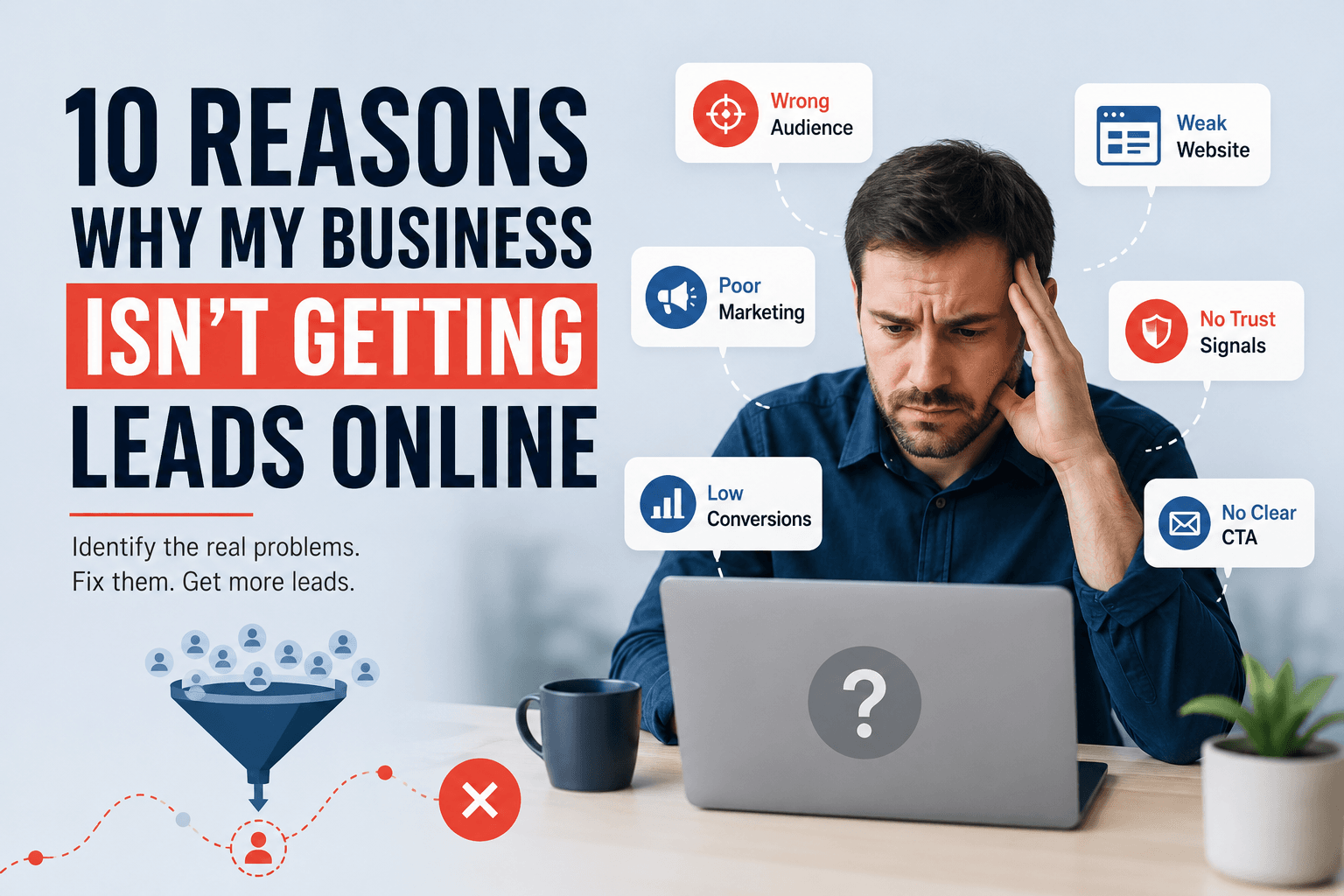
If you’ve been wondering why my business is not getting leads online, you’re not alone. Thousands of business owners, freelancers, and e-commerce founders ask the same question every day. They invest in websites, publish blog posts, run ads, and work on SEO, yet inquiries remain low and sales do not grow as expected.
The truth is that traffic alone does not build a successful business.
A visitor is simply someone who lands on your website. A prospect is a person who shows genuine interest in what you offer. A customer is someone who trusts you enough to take action and make a purchase. Moving people from one stage to the next requires much more than rankings or page views.
One of the biggest misunderstandings in digital marketing is the belief that more visitors automatically create more revenue. In reality, businesses grow when they attract the right audience, communicate clearly, build trust, and make it easy for people to take the next step.
A website that generates ten qualified inquiries every month is far more valuable than one that attracts thousands of visitors who never become customers.
The good news is that most lead generation problems can be fixed. They are usually connected to messaging, user experience, search intent, trust signals, or conversion strategy rather than a lack of traffic itself.
In this guide, we’ll explore the ten most common reasons businesses struggle to generate leads online. You’ll learn practical solutions that work for small businesses, global brands, e-commerce stores, and new freelancers alike. By the end, you’ll understand how to turn website visitors into real opportunities and build an online presence that supports long-term growth instead of simply collecting page views.
Why Is My Website Getting Visitors but No Leads?
Getting website traffic feels exciting.
You check Google Analytics, see hundreds or even thousands of visitors every month, and assume that leads will naturally follow. But then reality hits. The phone is quiet, contact forms remain empty, and sales inquiries never arrive.
If that sounds familiar, the problem is probably not your traffic.
In most cases, the real issue is what happens after people land on your website.
The Real Problem Is Usually Messaging, Not Traffic
Many businesses focus all their energy on attracting visitors but very little on communicating value.
Think about it from a customer’s perspective.
Someone clicks on your website because they have a question, a challenge, or a problem they want to solve. If your message is unclear, they leave and continue searching.
Strong messaging answers three simple questions immediately:
What do you do?
Who do you help?
Why should I choose you instead of someone else?
Unfortunately, many websites replace clarity with marketing language.
Statements like:
We deliver innovative solutions for modern businesses.
sound impressive but tell visitors almost nothing.
A small business owner, an e-commerce founder, or a freelancer looking for help wants straightforward answers.
People connect with clear benefits, not complicated words.
What New Visitors Need to Understand in Five Seconds
The first few seconds matter more than most business owners realize.
Before visitors read your services page or browse your blog, they make a quick decision:
Should I stay here or leave?
Your homepage should immediately communicate four things.
Who You Help
Be specific about your audience.
Instead of saying:
We help businesses grow.
Try:
We help e-commerce brands increase online sales through conversion-focused SEO strategies.
Specific messages attract better prospects.
What Problem You Solve
People buy solutions, not services.
Customers care about outcomes:
More leads
More sales
Better visibility
Lower advertising costs
Higher conversion rates
Your messaging should reflect those goals.
Why They Can Trust You
Trust is built through proof.
Include:
Customer testimonials
Case studies
Real project examples
Client logos
Clear contact information
Visitors need confidence before taking action.
What They Should Do Next
Never make people guess.
If the next step is booking a consultation, downloading a guide, or requesting a quote, make that obvious.
Clarity creates momentum.
Confusion creates exits.
A Simple Fix That Works for Small Businesses
You do not need a complete website redesign to improve lead generation.
Start with one exercise.
Ask someone who has never seen your website before to answer these questions within ten seconds:
What does this business do?
Who is it for?
What problem does it solve?
What should I do next?
If they struggle to answer, your messaging needs work.
A practical improvement is to rewrite your homepage headline using this simple framework:
We help [target audience] achieve [specific result] through [your solution].
For example:
We help small online stores increase sales through data-driven digital marketing and conversion optimization.
Simple language builds trust.
Clear promises attract qualified leads.
And when visitors immediately understand your value, they are far more likely to become customers instead of just another number in your analytics report.
Why Don't People Trust My Business Website?
Trust is the foundation of every online sale.
People rarely buy from businesses they do not trust, no matter how attractive the website looks or how much traffic it receives. If visitors leave your website without contacting you, one important question deserves attention:
Have you given them enough reasons to believe in your business?
Today, customers research before they buy. They compare options, read reviews, check social proof, and look for signs that a company is genuine.
Without trust, even great products and services struggle to generate leads.
Missing Reviews, Photos, and Real Proof
Many small businesses make the mistake of talking about quality without showing evidence.
Visitors want proof, not promises.
Think about your own buying behavior.
Before purchasing a product or hiring a service, you probably check:
Customer reviews
Real client experiences
Business photos
Case studies
Testimonials
Team information
Your customers do exactly the same thing.
If your website only contains stock images and general claims, people naturally become cautious.
Real proof creates confidence.
Simple trust signals include:
Google reviews
Client success stories
Before-and-after examples
Verified testimonials
Real photos of your team
Customer video feedback
Industry certifications
These elements help visitors feel that there are real people behind the business.
And real businesses earn trust faster.
Why Generic Marketing Language Hurts Conversions
One of the biggest conversion killers is vague marketing language.
Many websites use phrases like:
We are industry leaders.
We provide world-class solutions.
Customer satisfaction is our top priority.
The problem is simple.
Almost every business says the same thing.
Customers have learned to ignore these statements because they offer no evidence.
Specific information always performs better.
Instead of saying:
We deliver excellent service.
Try something more concrete:
We helped an online fashion store increase repeat purchases by 22% within six months through email automation and customer retention strategies.
Real details feel honest.
They create credibility.
And they help visitors imagine similar results for their own businesses.
Good marketing is not about sounding impressive.
It is about being understandable, believable, and helpful.
Building Trust Before Asking for a Sale
Many businesses ask for contact information before establishing confidence.
That approach often creates resistance.
Trust should come first.
Sales come second.
Before inviting visitors to schedule a call or request a quote, provide answers to the questions already in their minds:
Who Are You?
Introduce the people behind the business.
Customers prefer working with humans, not anonymous brands.
Have You Helped Others Like Me?
Show examples that reflect your ideal audience.
If you work with e-commerce companies, showcase e-commerce results.
If you help freelancers, share freelancer success stories.
Relevance strengthens trust.
What Happens After I Contact You?
Uncertainty creates hesitation.
Explain your process clearly.
For example:
Free consultation
Business analysis
Custom strategy proposal
Implementation support
People feel more comfortable when they know what to expect.
Is There Any Risk?
Simple assurances reduce anxiety.
Examples include:
No-obligation consultations
Transparent pricing
Flexible contracts
Satisfaction guarantees
The easier and safer the process feels, the more likely people are to take action.
At the end of the day, trust is not built through bold claims.
It is built through transparency, proof, consistency, and genuine human connection.
Businesses that invest in trust almost always generate better leads than businesses that focus only on getting more traffic.
Why Am I Ranking on Google but Still Not Getting Customers?
This is one of the most common frustrations I see with business websites.
You check Google Search Console or analytics and everything looks “good”—you’re getting impressions, clicks, even solid rankings. But the phone isn’t ringing, and enquiries aren’t coming in.
That gap usually comes down to one thing:
You’re getting traffic, but not the right kind of traffic.
Traffic Without Buyer Intent
Not all website visitors are equal.
Some people land on your site because they’re curious. Others are comparing options. A much smaller group is actually ready to buy.
If your traffic is mostly informational, you’ll always feel this disconnect—numbers going up, but revenue staying flat.
You’ll usually notice it here:
Lots of blog traffic, but very few enquiries
People read content but don’t explore services
Rankings improve, but leads don’t move
The problem isn’t SEO itself. It’s who you’re attracting.
The Difference Between Information Keywords and Purchase Keywords
Search intent changes everything.
Information Keywords (Research Mode)
These are people trying to understand something, not hire anyone yet.
For example:
“what is SEO”
“how does digital marketing work”
“how to grow a business online”
“social media marketing tips”
These users are early in the journey. They’re learning, exploring, and gathering ideas—but they’re not ready to spend money.
Purchase Keywords (Buying Mode)
Now compare that with search terms that show intent:
“SEO agency in Abu Dhabi”
“hire digital marketing expert”
“web design company near me”
“pricing for lead generation services”
This is a completely different mindset. These users already know what they need—they’re just deciding who to buy from.
How to Attract Visitors Who Actually Need Your Service
If your goal is customers (not just traffic), your SEO strategy has to shift toward intent, not volume.
1. Focus on Service-Driven Searches
Start prioritising keywords that signal action, such as:
hire
agency
service
company
pricing
near me
These are strong indicators that someone is close to making a decision.
2. Build Pages That Sell, Not Just Explain
A lot of websites over-invest in blog content and under-invest in service pages.
Your service pages should clearly show:
What you do
Who you help
What results look like
Proof that you’ve done it before
If a page doesn’t guide someone toward enquiry, it’s just information—not a business asset.
3. Match Content to Where the Buyer Is in Their Journey
Think of it like this:
Early stage → Educational content
Mid stage → Comparisons and insights
Late stage → Service pages and offers
Most businesses only show up in the early stage, which brings traffic—but not customers.
4. Design for Action, Not Just Rankings
Even if you rank well, people still need a reason to contact you.
Make it easy for them:
Clear call-to-action
Visible contact options
Trust elements (reviews, case studies, results)
Simple explanation of your process
If someone has to “figure out” how to work with you, they usually won’t.
Final Thought
Ranking on Google is just visibility.
But visibility without intent is noise.
Once you start aligning your content with how people actually buy—not just what they search—you stop chasing traffic and start generating real enquiries.
That’s when SEO starts feeling like a business tool, not just a marketing metric.
Why Does My Website Look Good but Still Fail to Convert?
This is a situation I see constantly: a website that looks polished, modern, even expensive—yet performs poorly when it comes to enquiries, calls, or sales.
The misunderstanding here is subtle but critical:
Design is not the same thing as performance.
A visually appealing website can still fail if it does not guide the visitor clearly toward a decision.
Design Is Not the Same as User Experience
Good design often gets confused with good UX, but they are not identical.
Design is how something looks.
User experience is how something works.
A website can have:
- Clean layouts
- Strong branding
- High-quality visuals
…and still leave users unsure of what to do next.
When that happens, visitors don’t complain—they simply leave.
From a behavioural perspective, users are not evaluating your design. They are constantly asking themselves:
“Is this clear, and does it help me solve my problem quickly?”
If the answer is not immediate, even a beautiful website fails.
Removing Friction From the Customer Journey
Conversion rarely fails because of one major issue. More often, it fails because of small points of friction that accumulate.
Friction looks like:
- Unclear messaging above the fold
- Too many competing calls-to-action
- Important information buried too deep
- Excessive scrolling before value is communicated
- Uncertainty about what happens next
Each of these may seem minor in isolation, but together they create hesitation.
And hesitation is where conversions disappear.
A high-performing website feels effortless. The user never has to stop and think, “What should I do here?”
That clarity is intentional—it is designed, not accidental.
One Goal Per Page Works Best
One of the most overlooked principles in conversion-focused design is focus.
A page that tries to achieve multiple goals usually achieves none of them effectively.
For example, a homepage that simultaneously tries to:
- Explain the company
- Sell multiple services
- Capture email signups
- Promote blog content
- Push social media
…ends up diffusing attention.
In contrast, high-converting pages tend to follow a single dominant objective.
That could be:
- Book a consultation
- Request a quote
- Understand a specific service
- Download a resource
Everything on the page should support that one action.
When users are given fewer choices, decision-making becomes easier—not harder.
This is a well-established principle in behavioural psychology: clarity increases action, while complexity reduces it.
Core Insight
A website does not fail because it is unattractive.
It fails because it does not guide the user clearly from interest to action.
Once you shift your thinking from “How does my website look? to How does my website behave for the user?, conversion improvements become far more predictable—and significantly more impactful.
Why Aren't People Clicking My Contact Button?
A contact button is one of the most important elements on a website—but it’s also one of the most misunderstood.
Many businesses assume that if the button exists, people will use it. In reality, users only click when the next step feels obvious, safe, and worth their time.
When that doesn’t happen, the issue is rarely technical—it’s psychological.
Weak Calls to Action
A call to action fails when it doesn’t create clarity or motivation.
Buttons like:
- “Submit”
- “Click here”
- “Contact us”
are technically correct, but emotionally empty.
They don’t answer the user’s internal question:
“What do I get if I click this?”
A strong call to action is specific and outcome-driven:
- “Get a Free Consultation”
- “Request Pricing in 24 Hours”
- “Speak to an Expert”
- “Book Your Strategy Call”
The difference is subtle in wording, but significant in performance.
Too Many Choices Create Confusion
One of the most common conversion killers is offering too many paths at once.
When a visitor sees:
- Call us
- Email us
- Fill a form
- Download a brochure
- Chat on WhatsApp
they often do none of them.
This is a classic behavioural effect—decision fatigue. The more options you provide, the less likely people are to choose any.
A high-performing page doesn’t overwhelm. It guides.
Making the Next Step Obvious
If users have to “figure out” what to do next, most won’t bother.
Strong conversion pages make the journey feel almost inevitable:
- Clear headline
- Clear value proposition
- One primary action
- Visible and repeated CTA
The goal is not persuasion through pressure. It is clarity through structure.
When users understand the value and the next step in seconds, clicks increase naturally.
Why Is My E-Commerce Store Getting Traffic but No Sales?
Traffic without sales in e-commerce is usually a symptom of unanswered questions, not lack of interest.
People are often interested—but not convinced.
Product Pages That Don’t Answer Buyer Questions
Most product pages focus on features, not decisions.
But customers are not just asking:
- What is this product?
They are also asking:
- Will this work for me?
- Is it worth the price?
- How does it compare?
- What if I don’t like it?
If your page doesn’t answer these, hesitation replaces intent—and hesitation kills sales.
Strong product pages include:
- Clear benefits (not just features)
- Real use cases
- High-quality images
- FAQs
- Comparison context
Shipping, Returns, and Trust Factors
Even when people like a product, they still hesitate if trust is unclear.
Common silent objections include:
- “How long will delivery take?”
- “Can I return it easily?”
- “What if it’s not what I expect?”
If these are not answered clearly, customers often abandon checkout.
Trust is not a design element—it is a decision factor.
Simplifying the Buying Process
Every extra step in checkout reduces conversions.
Complicated forms, forced account creation, or unclear pricing all introduce friction.
High-performing stores do three things well:
- Reduce steps to purchase
- Make pricing transparent
- Remove unnecessary decisions
The easier the process feels, the higher the conversion rate.
Why Am I Not Getting Local Customers From Google?
Local SEO failures are rarely about ranking alone—they are about relevance and trust within a specific area.
Common Local SEO Mistakes
Many businesses target keywords broadly instead of locally, or they rank without building local authority signals.
Common issues include:
- No location-specific service pages
- Weak or inconsistent business information
- Lack of local keywords in content
Ranking without local relevance often brings traffic—but not nearby customers.
Google Business Profile Problems
Your Google Business Profile is often more important than your website for local visibility.
Problems that reduce performance include:
- Incomplete business information
- No reviews or outdated reviews
- Poor category selection
- Lack of posts or updates
Google relies heavily on this profile to decide whether to show your business locally.
If it’s weak, your visibility suffers—even if your website is strong.
Creating Location-Based Trust Signals
Local customers need confirmation that you actually serve their area.
Strong trust signals include:
- Location-specific testimonials
- Case studies from local clients
- Mentions of neighborhoods or service areas
- Local photos and real business presence
People don’t just want a service—they want a service that feels close, accessible, and proven in their area.
Why Aren't My Blog Posts Bringing Me Clients?
This is a very common frustration—especially for businesses that are doing “content marketing” consistently but not seeing enquiries or sales from it.
The issue is usually not the quality of writing. It is the purpose behind the content.
Most blog posts are written to rank, not to convert.
And those are two very different goals.
Writing for Search Engines Instead of Humans
When content is created mainly to satisfy SEO guidelines, it often becomes:
- Too broad
- Too informational
- Too disconnected from real buying situations
It might rank well, but it doesn’t speak to a person who is ready to take action.
A reader can understand your content, appreciate it, and still have no reason to contact you.
That’s where the gap appears.
Good content should not only answer a question—it should guide a decision.
Educational Content vs. Conversion Content
Not all content is meant to generate leads immediately.
Educational content builds awareness:
- “What is digital marketing?”
- “How SEO works”
- “Benefits of social media marketing”
This attracts attention—but early-stage attention.
Conversion content is different. It speaks to intent:
- “SEO services in Abu Dhabi”
- “Hire a digital marketing agency”
- “Lead generation services pricing”
Most websites overproduce educational content and underinvest in conversion-focused pages.
As a result, they get readers—but not clients.
Turning Readers Into Leads
A blog post should not end the conversation. It should continue it.
Yet many articles simply inform and stop there.
To turn readers into leads, content must:
- Connect the topic to a real problem your service solves
- Show relevance to your offer
- Include a natural next step
That does not mean forcing sales language into every paragraph.
It means ensuring the reader is never left wondering:
“Okay… but what do I do with this information?”
Without that bridge, content remains academic—not commercial.
Why Are My Google Ads Not Generating Leads?
Paid traffic is often expected to deliver immediate results. When it doesn’t, the assumption is usually that the ads are the problem.
In reality, the issue is often what happens after the click.
Sending Paid Traffic to Weak Landing Pages
Google Ads can only amplify what already exists.
If the landing page is unclear, slow, or generic, even highly targeted traffic will not convert.
Common problems include:
- Pages that look like homepages instead of focused landing pages
- Too much information without a clear action
- Weak or missing trust signals
A good ad brings attention. The landing page must close the decision.
Poor Keyword Intent
Another major issue is targeting keywords that don’t match buying intent.
Clicks are not all equal.
Some searches are:
- Research-based
- Comparison-based
- Purchase-ready
If your ads are attracting people in research mode, you will get traffic—but weak lead quality.
Successful campaigns align message, keyword, and intent in one straight line.
Fixing the Entire Funnel, Not Just the Ad
A common mistake is trying to “fix ads” while ignoring the system around them.
In reality, performance depends on the full funnel:
- Ad message
- Landing page clarity
- Offer strength
- Trust elements
- Follow-up process
When one part is weak, everything underperforms.
Why Do New Freelancers Struggle to Get Clients Online?
Most freelancers assume the problem is lack of skill or experience.
In most cases, that is not true.
The real issue is positioning.
Positioning Matters More Than Skill
Clients don’t hire the most skilled freelancer.
They hire the one who feels most relevant to their problem.
If your message is:
- “I do web design”
- “I offer marketing services”
you are competing with everyone.
Positioning shifts perception:
- “I help restaurants increase online orders through conversion-focused websites”
- “I help coaches generate leads through Instagram funnels”
Skill is important—but positioning determines visibility and trust.
Building Authority Without Years of Experience
Authority is not only built through time. It is built through clarity and evidence.
Even new freelancers can build credibility by showing:
- Small wins
- Case studies (even personal or test projects)
- Clear niche focus
- Specific outcomes
People trust specificity more than vague experience claims.
The Power of Niching Down
Generalists struggle because they are unclear.
Niches win because they are focused.
When you narrow your audience:
- Your message becomes sharper
- Your content becomes more relevant
- Your conversions become higher
Clarity beats competition.
How Do Successful Businesses Consistently Generate Leads Online?
Consistent lead generation is rarely about one tactic.
It is about system thinking.
They Focus on Trust Before Traffic
High-performing businesses don’t rush traffic.
They first make sure:
- Their message is clear
- Their offer is understandable
- Their proof is visible
Only then do they scale traffic.
They Understand Customer Intent
Successful businesses don’t just attract visitors.
They attract intent.
They design content, ads, and pages around what people are ready to do—not just what they are curious about.
They Treat Their Website as a Sales System
To them, a website is not a brochure.
It is a structured system that:
- Attracts the right audience
- Builds trust
- Answers objections
- Guides decisions
- Converts attention into action
Every page has a purpose. Every step has logic.
Frequently Asked Questions
Why is my website getting traffic but no sales?
This usually comes down to a mismatch between attention and intent.
Traffic simply means people are visiting your site. Sales only happen when those visitors already have a problem they are ready to solve—and they trust you enough to solve it.
In most cases, businesses attract:
- Informational visitors (researching, not buying)
- Broad keyword traffic (low intent)
- Or users who don’t clearly understand the offer
So the website is doing the “visibility” part correctly, but failing at the “decision” part.
A strong conversion path requires three things:
clarity in messaging, relevance in traffic, and trust in the offer.
Without those, traffic remains just numbers.
How long does it take to generate leads from SEO?
SEO is not a quick-response channel—it behaves more like an asset than an ad.
For most businesses:
- Early signals (impressions, rankings): 1–3 months
- Consistent traffic growth: 3–6 months
- Stable lead generation: 6–12 months
However, the timeline changes based on competition, website strength, and content quality.
The important point is this: SEO compounds. Early effort looks slow, but results accelerate as authority builds.
Businesses that succeed with SEO treat it as long-term positioning, not immediate lead generation.
What is a good website conversion rate?
There is no universal number that applies to every business.
However, as a general benchmark:
- 1%–2%: average performance
- 2%–5%: strong performance
- 5%+: highly optimized, focused funnels
But conversion rate alone can be misleading.
A better question is:
Are the right visitors taking the right actions?
A smaller conversion rate with high-quality leads is often more valuable than a high rate with irrelevant inquiries.
Why do small businesses struggle with online marketing?
Most small businesses don’t struggle because of competition—they struggle because of clarity.
Common issues include:
- Trying too many marketing channels at once
- Weak positioning (“we do everything for everyone”)
- Inconsistent messaging across platforms
- Lack of trust signals like reviews or case studies
Online marketing rewards focus.
When a business tries to speak to everyone, it ends up resonating with no one.
Should I invest in SEO or Google Ads first?
It depends on time, budget, and stage of the business.
Google Ads is faster—you can generate visibility immediately—but it stops the moment you stop paying.
SEO is slower—but it builds long-term authority and reduces dependency on ad spend.
A practical approach many experienced businesses follow is:
- Start with Google Ads for immediate data and leads
- Use SEO to build long-term stability
In reality, the strongest systems use both—but at different stages of growth.
How can freelancers get clients without spending money on ads?
Freelancers don’t need ads to get clients—they need positioning and visibility in the right places.
The most effective organic strategies include:
- A clearly defined niche (not general services)
- Proof-based portfolio (even small or self-initiated work)
- Direct outreach with relevance, not spam
- Consistent presence on platforms where clients already search
The biggest mistake freelancers make is selling skills instead of outcomes.
Clients don’t hire “designers” or “marketers”—they hire solutions to specific problems.
Why do people leave my website without contacting me?
Most visitors leave not because they are uninterested, but because they are uncertain.
Uncertainty comes from:
- Unclear value proposition
- No visible trust signals
- Confusing navigation or too many choices
- Lack of clarity about what happens next
A website should answer three silent questions immediately:
- What is this?
- Is it relevant to me?
- Can I trust it?
If any of these are unclear, users exit without hesitation.
How many calls to action should a page have?
In principle, a page should have one primary goal.
This does not mean only one button exists—but it means there should be one dominant action guiding the page.
Too many calls to action create cognitive friction. The user is forced to decide how to act instead of whether to act.
A strong page structure typically includes:
- One main call to action (primary)
- One or two secondary supporting actions
For example:
Primary: “Book a Consultation”
Secondary: “View Case Studies” or “Learn More”
When the hierarchy is clear, decision-making becomes easier—and conversions improve naturally.
Final Thoughts
The internet has become more competitive than ever, and that competition is only increasing.
But the businesses that consistently win are not the ones shouting the loudest—they are the ones communicating the clearest message with the least friction.
At this stage, success online is no longer about visibility alone. It is about alignment: between what people are searching for, what they actually need, and what your business is offering.
When that alignment is missing, even strong marketing efforts struggle to convert.
What we consistently see across high-performing websites and campaigns is simple:
- Trust drives the first click of confidence
- Relevance determines whether attention continues
- User experience decides whether action happens
Traffic can be bought, ranked, or generated in many ways—but trust and clarity must be earned.
Sustainable lead generation is not built on hacks or isolated tactics. It comes from a more fundamental principle:
Solve real problems for real people, in a way they immediately understand.
When that happens, marketing stops feeling like persuasion—and starts functioning like guidance.
And that is where consistent growth truly begins.
