
1 What Is SEO?
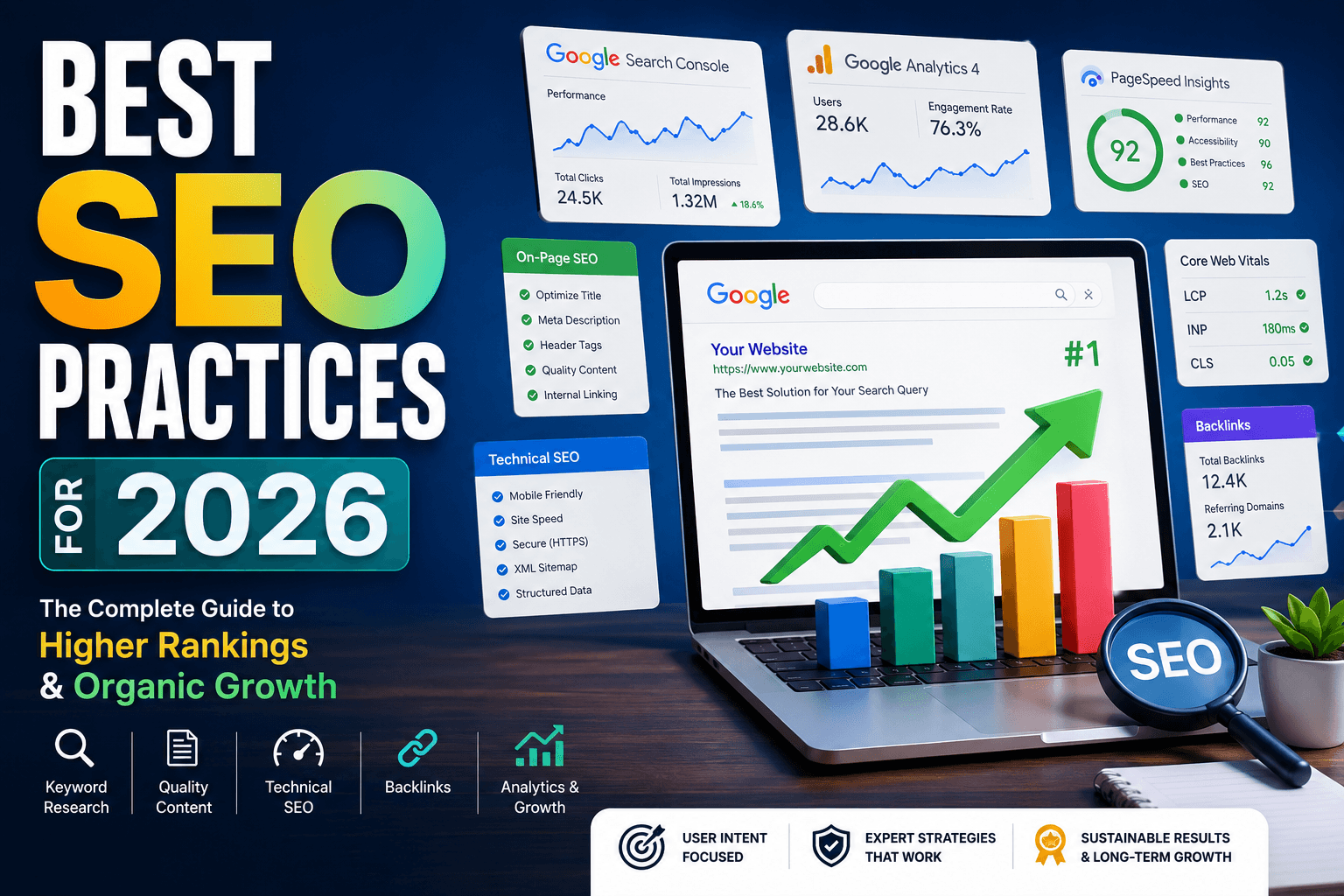
Best SEO Practices for 2026:- SEO (Search Engine Optimization) is the process of improving a website so that search engines can understand, trust, and recommend it to users searching for relevant information, products, or services.
At its core, SEO is about connecting the right people with the right answers at the right time.
Search Engine Optimization (SEO) is one of the most misunderstood disciplines in digital marketing.
Many people believe SEO means adding keywords, buying backlinks, or following secret tricks to rank on Google. In reality, modern SEO is far more sophisticated. ( SEO VS GOOLE ADS)

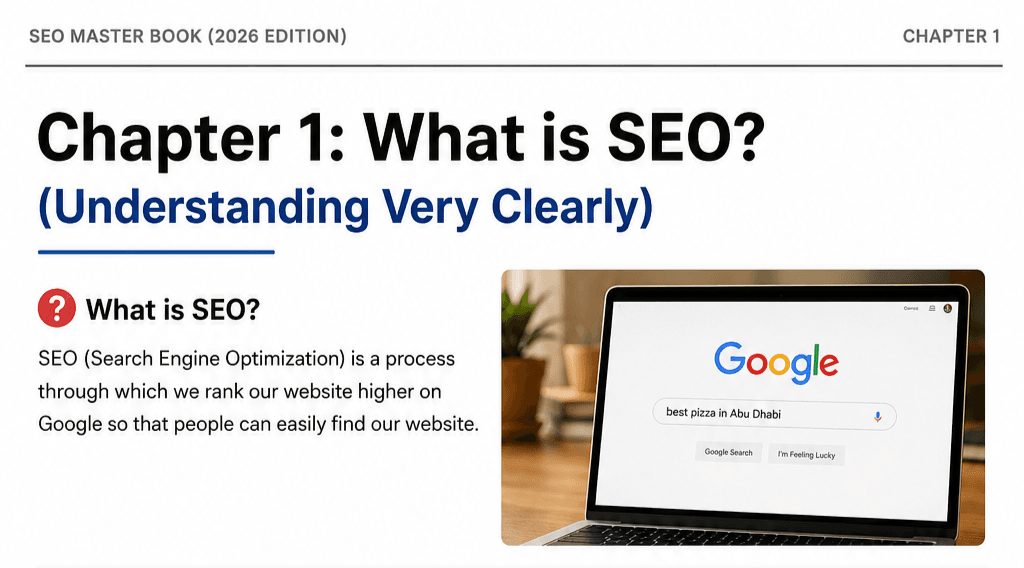
Think of Google as a giant library where every website is a book. When someone searches for “best pizza in Abu Dhabi,” Google selects the books that are most relevant, trustworthy, and useful. SEO helps your website become one of those top recommendations.
Modern SEO focuses on four key areas: helpful content, technical performance, authority, and user experience. By creating valuable information, maintaining a fast and mobile-friendly website, and building trust, you increase your chances of long-term success.
Simply put, SEO is the art of becoming the best answer for your audience and helping search engines recognize that value.
How Search Engines Work-

1. Webpage Publication
The process begins when you publish a webpage on your website. This page can contain text, images, videos, and other information designed to help users solve a problem or answer a question.
2. Search Engine Robots Crawl Your Page
Search engines send automated programs, known as crawlers or bots, to discover new and updated content. These bots follow links across the web and collect information about your pages.
3. Search Engines Index the Content
After crawling, the search engine analyzes your content and stores it in its index—a massive digital library of web pages. Pages that are accessible, valuable, and properly structured are more likely to be indexed successfully.
4. Algorithms Determine Rankings
When users perform a search, complex algorithms evaluate hundreds of factors, including relevance, content quality, page speed, mobile usability, authority, and user experience, to decide which pages deserve higher positions.
5. Your Webpage Appears in the SERP
Finally, the most relevant and helpful pages are displayed on the Search Engine Results Page (SERP). Websites that best satisfy user intent earn better visibility and attract more organic traffic.
In short, search engines discover, understand, evaluate, and rank webpages to provide users with the most useful answers possible.
SEO Process

1. Establish Your Areas of Expertise and Business Priorities
Successful SEO starts with clarity. Define the topics your brand truly understands and identify the products, services, or goals that matter most. Building authority around a focused niche creates stronger rankings and long-term trust.
2. Conduct Keyword Research and Search Intent Analysis
Find the terms your audience is searching for and understand the intent behind those searches. A keyword only creates value when your content matches what users actually want—whether they are looking to learn, compare, or buy.
3. Perform a Technical SEO Audit and Implement Optimizations
Ensure your website is fast, mobile-friendly, secure, and easy for search engines to crawl and index. Fixing technical issues such as broken links, poor site structure, and slow loading times creates a strong foundation for growth.
4. Build High-Quality Backlinks and Referral Opportunities
Authority is earned through trust. Develop relationships, create valuable resources, and seek opportunities for reputable websites to mention and link to your content. Quality always outweighs quantity.
5. Publish Helpful, Well-Optimized Pages and Blog Content
Create lightweight, user-focused content that answers real questions and targets relevant keywords naturally. Every page should serve a clear purpose and provide genuine value to readers.
6. Measure Performance and Report on Key SEO Metrics
Track important metrics such as organic traffic, keyword rankings, click-through rates, conversions, engagement, and backlinks. Continuous analysis helps you refine your strategy and achieve sustainable results.
In short: Focus → Research → Optimize → Build Authority → Publish → Measure & Improve.
SEO Optimization Workflow
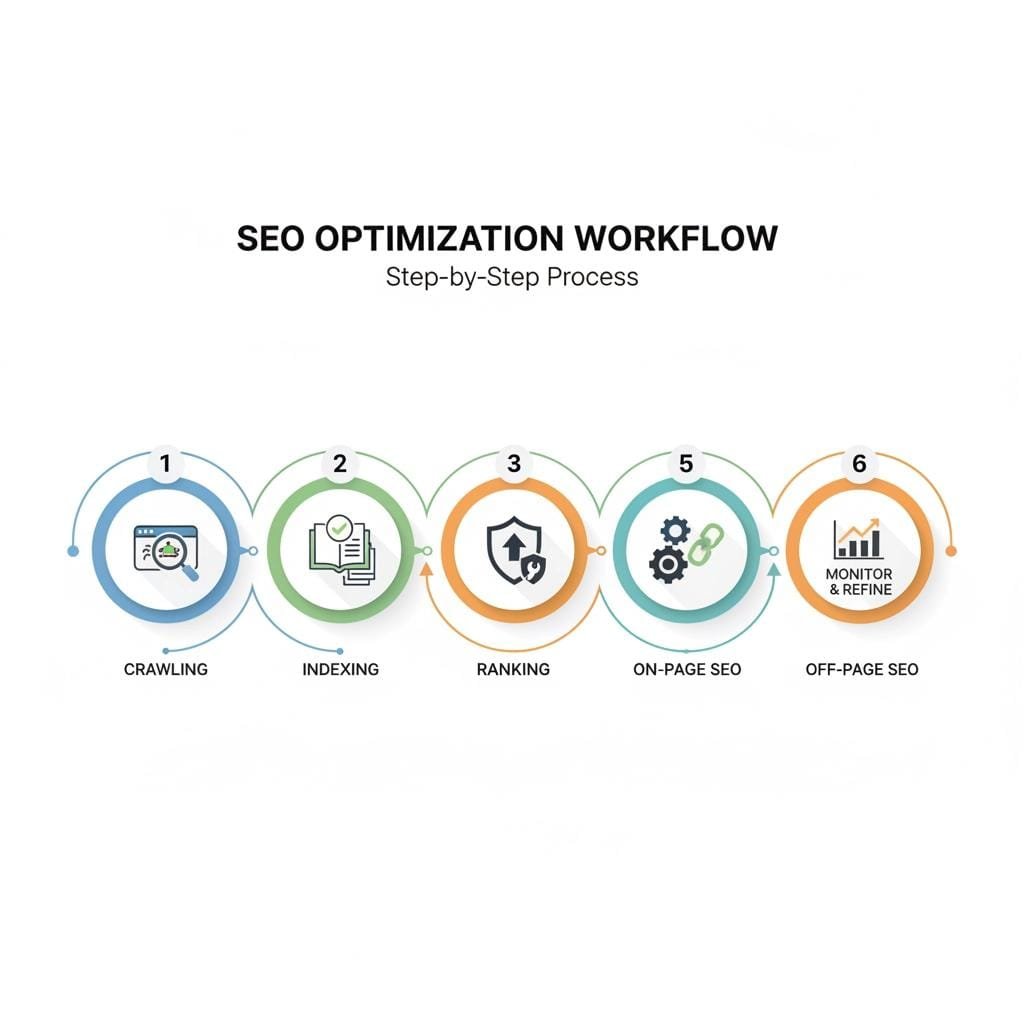
Step by step process
- Crawling – The process of bots systematically browsing the web to discover and collect new or updated pages.
- Indexing – Storing and organizing crawled web pages in a search engine database so they can be retrieved in results.
- Ranking – The algorithmic ordering of indexed pages in search results based on relevance, quality, and authority.
- On-Page SEO – Optimizing elements within a webpage (content, titles, keywords, meta tags) to improve search visibility.
- Off-Page SEO – Actions outside your website (backlinks, social signals, brand mentions) that improve search engine trust and authority.
A Simple Real-World Analogy
Imagine that Google is the world’s largest library.
Every website is a book within that library.
When someone searches:
“Best running shoes for beginners”
Google must determine:
- Which book answers the question most clearly?
- Which author is trustworthy?
- Which information is current and accurate?
- Which readers found the content helpful?
SEO is the process of making your book the one the librarian recommends first.
The Three Fundamental Pillars of SEO

Modern SEO is built on three core pillars: On-Page SEO, Off-Page SEO, and Technical SEO. Together, they determine how well a website communicates its relevance, authority, and usability to both users and search engines.
On-page SEO focuses on creating valuable, intent-driven content, off-page SEO strengthens trust and credibility across the web, and technical SEO provides the infrastructure that allows search engines to efficiently crawl, index, and deliver a seamless user experience.
When these three elements work together, they create a strong foundation for sustainable organic growth and long-term search visibility.
1. On-Page SEO
On-page SEO is basically how you fine-tune a single webpage so it actually deserves to rank. It’s about making your content clear, useful, and aligned with what people are searching for—while also helping search engines quickly understand what the page is about.
In practice, it means writing solid, helpful content, using keywords in a natural way (not stuffing them), structuring your headings so the page flows logically, and optimizing things like titles and meta descriptions so they’re both relevant and clickable. You also strengthen the page with internal links and make sure the overall experience feels smooth and easy to navigate for real users.
On-page SEO refers to everything you optimize within your website.
It includes:
- Content quality
- Keyword targeting
- Heading structure
- Internal linking
- Image optimization
- Meta titles and descriptions
- User intent alignment
Goal: Help search engines understand exactly what your page is about.
2. Technical SEO
Technical SEO is all about making sure your website is built in a way that search engines can easily access, crawl, and understand it. Think of it as the behind-the-scenes setup that keeps everything running properly.
It covers things like site speed, mobile friendliness, secure connections (HTTPS), clean site structure, proper indexing, fixing crawl errors, using structured data, and making sure there are no technical barriers stopping search engines from reading your pages. When technical SEO is done right, it gives your content and on-page efforts a solid foundation to actually perform in search results.

Technical SEO ensures that search engines can efficiently crawl, render, and index your website.
Key areas include:
- Site speed
- Mobile responsiveness
- Core Web Vitals
- XML sitemaps
- Robots.txt configuration
- Structured data
- Secure HTTPS implementation
Goal: Build a technically healthy website that delivers an excellent user experience.
3. Off-Page SEO
On-Page SEO is the process of optimizing individual web pages so they clearly communicate relevance to both search engines and users. It’s about shaping the page so it directly matches search intent and provides real value.
This includes writing high-quality, useful content, using keywords naturally in the right places, structuring headings for readability, optimizing titles and meta descriptions, and adding internal links to connect related pages. It also involves improving the overall user experience so visitors can easily find, understand, and engage with the content.
Off-page SEO involves signals that exist beyond your website itself.
Examples include:
- High-quality backlinks
- Brand mentions
- Digital PR
- Industry authority
- Social amplification
Goal: Demonstrate trust, expertise, and authority to search engines.
The Process of Search Engines


Modern search engines generally follow three major stages:
Step 1: Crawling
Crawling is the process where search engines send out automated bots (often called spiders) to browse the web and discover new or updated pages by following links from one page to another.
Search engine bots discover pages across the web by following links.
Step 2: Indexing
Indexing is the stage where a search engine processes the pages it has discovered, understands their content, and stores them in its database so they can appear in search results later.
During this step, the search engine analyzes things like text, keywords, structure, images, and metadata to figure out what the page is about and whether it’s good enough to be included in its searchable index.
The discovered pages are analyzed and stored within massive databases.
Step 3: Ranking
Step 3: Ranking is the process where search engines evaluate all the indexed pages and decide which ones should appear first for a given search query.
They use complex algorithms to measure relevance, content quality, authority, user experience, and hundreds of other signals to determine which results best match the user’s intent—and then arrange them from most to least useful.
When a user performs a search, algorithms determine which pages best satisfy that user’s intent.
The objective is not merely to find pages containing keywords, but to identify pages that provide the most valuable experience.
The Evolution of SEO
Early SEO (2000–2010)
Success often depended on:
- Keyword repetition
- Directory submissions
- Large numbers of backlinks
If your website does not understand users better than competitors, you will not rank — no matter how many backlinks you build.
🧠 CHAPTER 1: SEARCH ENGINE THINKING HAS CHANGED
Search engines in 2026 behave like AI evaluators, not keyword matchers.

They analyze:
- User intent depth
- Content satisfaction score
- Behavioral signals (scroll, dwell time)
- Entity trust (brand authority)
- Content originality fingerprint


🎯 Professor Insight:
If two pages have same keywords:
- Page A = shallow content
- Page B = solves problem deeply
👉 Page B wins every time — even with fewer backlinks.
KEYWORD STRATEGY IS NOW INTENT MAPPING?
Yes—this is actually a very accurate modern SEO shift.
Keyword strategy has evolved into intent mapping, where the focus is no longer just targeting individual keywords, but understanding why a user is searching in the first place.
Instead of building pages around isolated terms, you map content to search intent clusters—informational, navigational, commercial, and transactional—then create content that fully satisfies that intent with depth, context, and relevance. In simple terms, it’s less about “ranking for a keyword” and more about “solving the user’s need better than anyone else on the SERP.”
Old SEO:
- Find keyword
- Repeat keyword
- Rank
New SEO:
- Understand intent layer
- Map sub-intents
- Build content clusters
🧩 Example:-Best SEO Practices for 2026
Keyword: “best laptop for students”
Modern breakdown:
- Budget students
- Programming students
- Design students
- Battery-focused users
- Gaming students
Each needs separate content.

Topic Center Model (Hub & Spoke Model) is an SEO content strategy where a main “pillar page” (the hub) covers a broad topic in depth, and multiple related “supporting pages” (spokes) link back to it to cover subtopics in detail.
It helps search engines understand topical authority by clearly organizing content into a structured ecosystem, improving rankings through strong internal linking and comprehensive coverage of a subject.

Search intent mapping across SEO is the process of aligning different types of user intent—informational, navigational, commercial, and transactional—with the right content format and page type across your entire website.
Instead of targeting keywords one by one, you map the full search journey and create content that matches what users want at each stage, ensuring every query is answered with the most relevant and helpful page.

If you’re talking about search intent mapping across your website, it means organizing your entire site so every page matches a specific user intent and stage in the journey.
In simple terms:
You don’t just create content—you assign each page a clear purpose.
- Informational intent → Blog posts, guides, tutorials (people learning something)
- Navigational intent → Brand or service pages (people looking for a specific website or company)
- Commercial intent → Comparison pages, reviews, “best of” content (people researching before buying)
- Transactional intent → Product pages, service pages, landing pages (people ready to take action or buy)
When done right, your website becomes a structured system where every page answers a specific search need, and together they cover the full customer journey—from awareness to conversion.
TECHNICAL SEO IS NOW USER EXPERIENCE ENGINEERING
That’s a strong modern framing—and it’s largely true.
Technical SEO has evolved into User Experience Engineering, because search engines now reward sites that don’t just work technically, but feel fast, stable, and effortless for real users.
It’s no longer just about crawlability or indexing—it’s about how smoothly a user can interact with your site: fast load times, mobile-first design, clean architecture, zero friction navigation, and stable layouts (Core Web Vitals). In other words, technical SEO today is about building the infrastructure that delivers a seamless experience for both users and search engines.
In 2026, technical SEO is no longer just:
- Speed
- Sitemap
- Robots.txt
It is:
How smoothly a user experiences your website across every interaction.
Core Technical Priorities:
✔ Sub-2.5s LCP (critical ranking factor)
✔ Zero layout shift (CLS = 0 ideal)
✔ Minimal JavaScript blocking
✔ Edge caching
✔ Mobile-first rendering quality
As My Experience Tips:
A slow website is not “bad SEO” —
it is a bad user experience signal that kills ranking indirectly.
CONTENT QUALITY = SATISFACTION ENGINE?
Yes—this is actually a very accurate way to think about modern SEO.
Content quality is essentially a satisfaction engine, meaning its job is to fully satisfy the user’s intent after they click a result.
It’s not just about being well-written or keyword-optimized anymore. High-quality content keeps users engaged, answers their question completely, builds trust, and often removes the need to go back to search results (low “pogo-sticking”). In simple terms, the better your content satisfies the user, the stronger your rankings tend to be—because search engines measure success through user satisfaction signals.
Google no longer ranks content that is just “correct.”
It ranks content that:
- Fully answers the question
- Prevents return-to-search behavior
- Provides depth + clarity
- Builds trust in first 10 seconds


6
📌 Real Example:
❌ Weak content:
- “SEO is important for ranking websites…”
✔ Strong content:
- Step-by-step implementation
- Tools used
- Case studies
- Mistakes to avoid
- Real measurable outcomes
🔗 CHAPTER 5: BACKLINKS IN 2026 — QUALITY OVER EVERYTHING
Backlinks still matter, but:
One authoritative contextual backlink > 100 weak directory links
Modern backlink evaluation:
- Context relevance
- Site authority
- Entity alignment
- Traffic quality of linking page
🧠 Hidden Professor Tip:
Google now detects “unnatural backlink patterns” with AI clustering.
So spam links don’t just fail — they can silently suppress rankings.
🧭 CHAPTER 6: ENTITY SEO — THE MOST IMPORTANT SHIFT
Google now understands entities, not just words.
Example:
“Apple” = company OR fruit
“Jordan” = country OR person OR brand
Your goal:
Become a recognized entity in your niche


6
🧠 Insight:
If Google understands who you are,
you rank even for keywords you never optimized.
📱 CHAPTER 7: MOBILE SEO = PRIMARY SEO (NOT SECONDARY)
In 2026:
👉 80%+ searches are mobile-first indexed
👉 Google evaluates mobile UX as the main version
📱 Mobile SEO Is Primary SEO in 2026


The Reality
Google has fully completed its transition to mobile-first indexing. This means Google primarily uses the mobile version of your website for crawling, indexing, and ranking, even for desktop search results.

Google’s Official Position
Google states:
“Google uses the mobile version of a site’s content, crawled with the smartphone agent, for indexing and ranking.”
That is the strongest proof you can cite in a professional article because it comes directly from Google Search Central.
What Mobile-First Indexing Actually Means
Many people misunderstand this concept.
It does not mean:
❌ Google has a separate “mobile index.”
It does mean:
✅ Googlebot Smartphone is the primary crawler.
✅ The mobile version of your content is used to determine rankings.
✅ Content missing on mobile may not be fully indexed or understood by Google.
A Real Example
Imagine your desktop site contains:
- Full buying guides
- Structured data
- Internal links
- Product reviews
But your mobile version hides half of that content.
Google will primarily evaluate the mobile version, which means those missing elements may not contribute to rankings.
The Statement You Should Use in Your Book
Instead of writing:
❌ “80%+ searches are mobile-first indexed.”
Write:
✅ “Google now uses the mobile version of websites as the primary source for crawling, indexing, and ranking. Mobile-first indexing has been fully rolled out across the web, making mobile user experience a foundational requirement for modern SEO.”
Additional Evidence About Mobile Usage
If you want to discuss user behavior, you should phrase it carefully:
“In many countries, the majority of web searches now occur on mobile devices, which is one of the reasons Google transitioned entirely to mobile-first indexing.”
Avoid inventing precise percentages unless you have a recent, citable source for that exact statistic.
Professor’s Note
A hallmark of expert SEO writing is this principle:
Never publish a number, percentage, or ranking claim without a verifiable source.
Readers may forget tactics, but they remember trust. And trust is the foundation of both great books and great SEO.
Mobile ranking factors:
- Tap usability
- Font readability
- Layout simplicity
- Speed on 4G networks
- Sticky element behavior
🚀 CHAPTER 8: AI SEARCH & ZERO-CLICK FUTURE
Search engines now answer directly using AI summaries.
So your goal is:
Not just ranking — but being cited by AI systems.
How to win AI search:
✔ Write structured answers
✔ Use clear headings
✔ Provide factual depth
✔ Avoid fluff paragraphs
✔ Build authority content hubs
Honest Recommendation (MOST IMPORTANT)
If I had to reduce SEO 2026 into one sentence:
“Rankings belong to the website that satisfies the user fastest, deepest, and most completely.”
SEO is no longer a “marketing trick.”
It is:
A discipline of building trust between humans and machines.
The Complete SEO Professional’s Guide to Google Search Console, Google Analytics 4, and Google Properties
Everything Every SEO Expert Must Know in 2026


Introduction
If SEO were a hospital, then:
- Google Search Console (GSC) would be your diagnostic laboratory.
- Google Analytics 4 (GA4) would be your patient monitoring system.
- Google Tag Manager (GTM) would be your surgical instruments.
- PageSpeed Insights would be your health scanner.
- Google Business Profile would be your local reputation manager.
Without these tools, professional SEO work is incomplete. Google itself recommends Search Console for monitoring crawling, indexing, and search performance, while GA4 provides detailed user-behavior analysis. (Google Help)
Chapter 1: Google Search Console (GSC)


What Is Google Search Console?
Google Search Console is a free platform from Google Search Central that helps website owners monitor, maintain, and troubleshoot their presence in Google Search. It provides data on queries, clicks, impressions, indexing, crawling, links, and technical issues. (Google Help)
Why Every SEO Professional Uses GSC
1. Keyword Performance
You can see:
- Search queries
- Clicks
- Impressions
- CTR
- Average ranking positions
Example:
| Query | Clicks | Impressions | CTR | Position |
|---|---|---|---|---|
| best seo practices 2026 | 1,200 | 20,000 | 6% | 2.1 |
This is your most reliable source of organic performance data because it comes directly from Google. (Google Help)
2. URL Inspection
The URL Inspection tool allows you to verify:
- Indexing status
- Last crawl date
- Canonical URLs
- Mobile usability
- Structured data issues
Professional SEOs inspect important pages immediately after publishing updates. (Google)
3. Sitemaps
A sitemap helps Google discover pages more efficiently.
Best practice:
https://example.com/sitemap.xml
Always submit your sitemap after launching a new site or making major structural changes. (Google Help)
4. Core Web Vitals
The report measures:
- LCP (Largest Contentful Paint)
- CLS (Cumulative Layout Shift)
- INP (Interaction to Next Paint)
These metrics influence user experience and search visibility. (Google Help)
5. Link Analysis
GSC shows:
- External backlinks
- Internal links
- Top linked pages
Although not as detailed as commercial tools, Google’s own link data is invaluable. (Google Help)
Chapter 2: Google Analytics 4 (GA4)


What Is GA4?
Google Analytics 4 (GA4) is Google’s modern analytics system that replaced Universal Analytics. It uses an event-based model instead of a session-based model, enabling cross-device and cross-platform analysis. (SEO.com)
Why GA4 Matters for SEO
Search Console tells you:
How users arrived.
GA4 tells you:
What users did after arriving.
Professional SEO requires both.
Essential SEO Reports Inside GA4
1. Traffic Acquisition
Path:
Reports → Acquisition → Traffic Acquisition
Focus on:
- Organic Search users
- Engagement rate
- Sessions
- Conversions
2. Landing Pages Report
This report helps answer:
- Which pages attract traffic?
- Which pages convert?
- Which pages have poor engagement?
3. Engagement Metrics
Important measurements include:
- Average engagement time
- Engaged sessions
- Scroll depth
- Video interactions
- Conversion events
GA4 automatically tracks many interactions through its event-based architecture. (redseo.io)
Chapter 3: Understanding a GA4 Property


What Is a Property?
A property is the container that stores your website or app data.
Structure:
Google Account
   ↓
Analytics Account
   ↓
GA4 Property
   ↓
Data Stream
   ↓
Website Events
What Is a Data Stream?
Examples:
Website Stream
https://mywebsite.com
Android App Stream
My Android Application
iOS App Stream
My iPhone Application
Multiple streams can feed one property, allowing unified reporting. (SEO.com)
Chapter 4: Google Tag Manager (GTM)


Why SEO Professionals Love GTM
Before GTM:
Every tracking code required developer assistance.
After GTM:
Marketers can deploy:
- GA4 events
- Conversion tracking
- Scroll depth monitoring
- Form submissions
- Heatmap tools
- Custom pixels
without modifying website code.
Core Components
Tags
What should fire?
Examples:
- GA4 events
- Facebook Pixel
- LinkedIn Insight Tag
Triggers
When should it fire?
Examples:
- Page views
- Button clicks
- Form submissions
Variables
What data should be passed?
Examples:
- Page URL
- User ID
- Click text
Chapter 5: Google Business Profile (Local SEO)


Why It Matters
For local businesses, Google Business Profile influences:
- Google Maps rankings
- Local Pack visibility
- Reviews
- Calls
- Directions
- Website visits
Professional local SEO always includes:
- Category optimization
- Review management
- Photo uploads
- Local citations
- Regular posts
Chapter 6: PageSpeed Insights


Key Metrics
LCP
Target:
Under 2.5 seconds
CLS
Target:
Below 0.1
INP
Target:
Below 200 milliseconds
These metrics appear both in PageSpeed Insights and Search Console reports. (Google Help)
Chapter 7: How Professional SEOs Use All Tools Together
Google Search Console
      ↓
Find high-impression, low-CTR keywords

GA4
      ↓
Analyze engagement and conversions

Tag Manager
      ↓
Track events and user actions

PageSpeed Insights
      ↓
Improve technical performance

Google Business Profile
      ↓
Strengthen local visibility
The Professional Workflow
Every week:
Search Console
- Check indexing
- Review clicks and impressions
- Inspect declining pages
- Monitor Core Web Vitals
GA4
- Analyze organic traffic
- Review engagement
- Study conversions
- Identify weak landing pages
GTM
- Verify event tracking
- Check conversions
- Validate tags
Technical Tools
- Run Lighthouse audits
- Fix speed issues
- Monitor structured data
The Professor’s Final Principle
Search Console tells you how Google sees your website. Analytics tells you how users experience your website. Great SEO happens when both perspectives align.
That single principle separates amateur SEO from professional SEO practice. (Google Help)
Frequently Asked Questions About SEO in 2026
1. What is SEO?
SEO (Search Engine Optimization) is the practice of improving a website so search engines can better understand, trust, and recommend it to users searching for relevant information.
The ultimate goal is to increase organic visibility and attract qualified visitors.
2. Is SEO still worth investing in during 2026?
Absolutely.
Despite advances in AI and changing search experiences, organic search remains one of the most sustainable and cost-effective traffic channels.
Unlike paid advertising, strong SEO assets continue generating value long after publication.
3. How long does SEO take to show results?
For most websites:
- Low competition: 3–6 months
- Medium competition: 6–12 months
- High competition: 12 months or longer
SEO is a long-term investment rather than a quick tactic.
4. What matters more: content or backlinks?
Neither works effectively alone.
High-quality content provides value, while authoritative backlinks build trust.
The strongest websites excel at both.
5. What are Core Web Vitals?
Core Web Vitals measure user experience through metrics such as:
- Largest Contentful Paint (LCP)
- Interaction to Next Paint (INP)
- Cumulative Layout Shift (CLS)
These metrics help ensure websites remain fast, stable, and user-friendly.
6. Why is mobile SEO so important?
Google primarily uses mobile versions of websites for indexing and ranking.
A poor mobile experience can negatively affect overall search visibility, even for desktop users.
7. What is Google Search Console?
Google Search Console is a free tool that helps website owners monitor search performance, indexing, technical issues, backlinks, and keyword data directly from Google.
It is one of the most essential tools for every SEO professional.
8. What is Google Analytics 4 (GA4)?
GA4 is Google’s event-based analytics platform.
It helps businesses understand:
- User behavior
- Traffic sources
- Engagement
- Conversions
- Customer journeys
Search Console shows how users arrive; GA4 shows what they do afterward.
9. Does AI replace SEO?
No.
AI changes how people discover information, but strong SEO principles remain fundamental.
The future belongs to websites that combine human expertise, technical excellence, and AI-friendly content structures.
10. What is the single most important SEO principle?
Professor’s Final Answer
Become the best answer to a real human problem.
Algorithms evolve.
Technologies change.
But helping people better than anyone else remains the timeless foundation of successful SEO.
Final Thought
SEO in 2026 is not about manipulating search engines.
It is about building trust, demonstrating expertise, solving problems, and creating exceptional experiences that both users and search engines value.
